
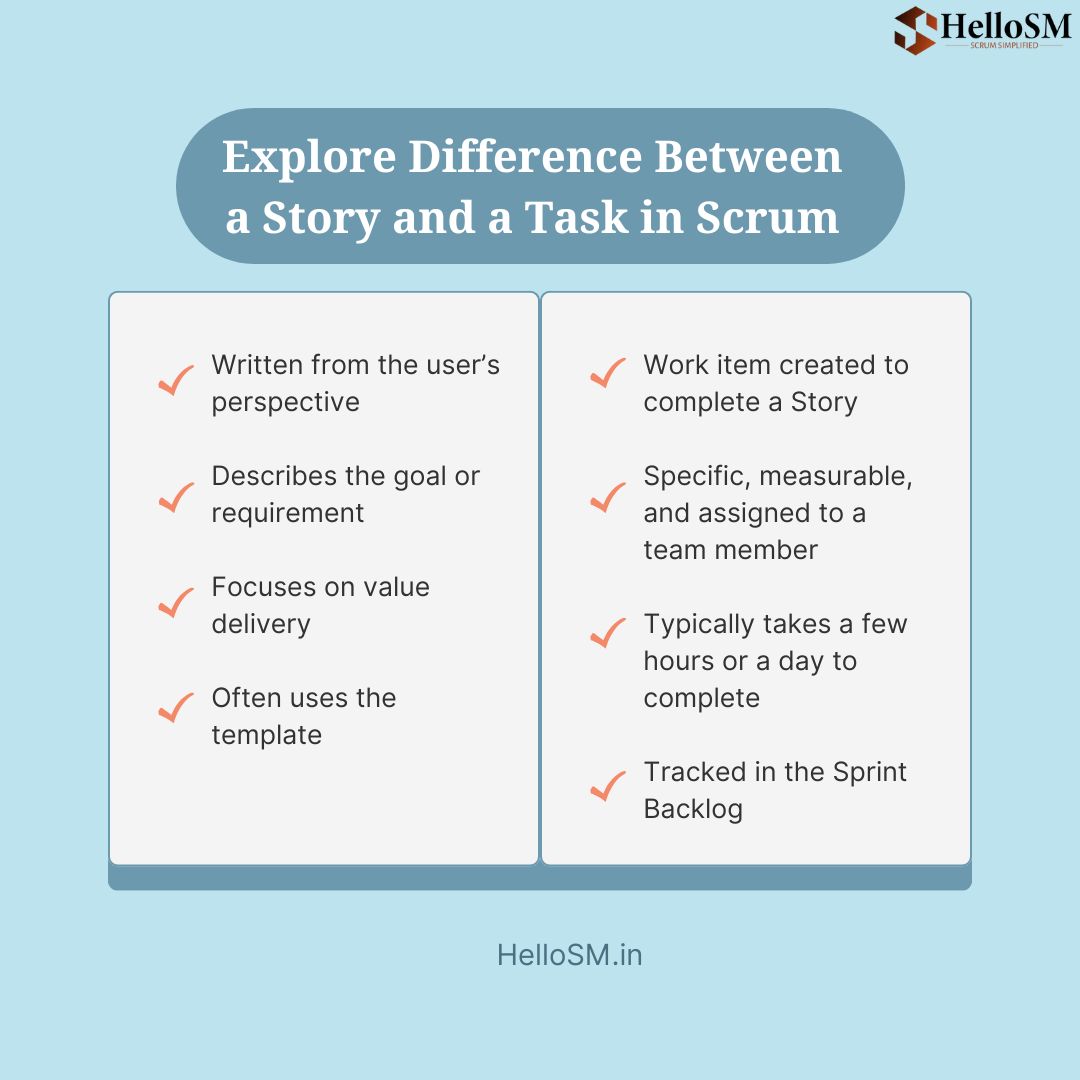
In Scrum, understanding the difference between a Story and a Task is crucial for successful Agile project management. Both play key roles in breaking down work and ensuring teams deliver value efficiently. If you are aiming to become a certified Scrum Master or improve your Agile skills, learning this is essential. At HelloSM, the best Scrum training institute in India, simplifying these concepts for real-world applications.
What is a Story in Scrum?
A Story often called a User Story is a description of a feature or functionality from the perspective of the end-user. It focuses on what the user needs and why they need it. Stories help the Scrum team understand the value of work and prioritize tasks that deliver the most benefit to the customer.
Key characteristics of a Story:
- Written from the user’s perspective
- Describes the goal or requirement
- Focuses on value delivery
- Often uses the template: “As a [user], I want [feature] so that [benefit].”
Example:
“As a registered user, I want to reset my password via email so that I can regain access if I forget it.” Stories are larger pieces of work that usually span multiple tasks and may take a few days or a sprint to complete. They are tracked in the product backlog and prioritized by the Product Owner.
What is a Task in Scrum?
A Task is a smaller, actionable item that breaks down a Story into work that team members can complete. Tasks are technical or operational steps that need to be done to implement a Story.
Key characteristics of a Task:
- Work item created to complete a Story
- Specific, measurable, and assigned to a team member
- Typically takes a few hours or a day to complete
- Tracked in the Sprint Backlog
Example: For the above Story (password reset):
- Design the password reset page
- Implement the backend email logic
- Test the password reset functionality
Tasks are sub-components of a Story, making it easier for teams to distribute work and track progress during a sprint.
Why This Difference Matters?
Understanding the difference between Stories and Tasks ensures that Scrum teams:
- Focus on delivering value, not just completing work
- Break work into manageable pieces
- Improve planning and estimation
- Maintain transparency and accountability during the sprint
Scrum is about iterative delivery, and distinguishing Stories from Tasks is critical for sprint planning, daily stand-ups, and retrospectives.
Real-World Example
Imagine a team building an e-commerce application.
Story:
“As a customer, I want to add products to a wishlist so that I can save items for later purchase.”
Tasks:
- Design the wishlist UI
- Create the backend database structure for wishlists
- Integrate wishlist feature with the product catalog
- Test the wishlist functionality
By breaking Stories into Tasks, the team can assign work efficiently, track progress, and ensure high-quality delivery. Stories and Tasks are both essential in Scrum, but they serve different purposes. A Story describes the what and why of a feature, focusing on user value, while a Task explains how to implement that feature through smaller, actionable work items.
Understanding this difference enhances team productivity, planning accuracy, and delivery quality. For professionals looking to master Scrum and Agile practices, enrolling at HelloSM, the best Scrum training institute in India, provides hands-on learning and real-world examples to strengthen these concepts.
By clearly distinguishing between Stories and Tasks, Scrum teams can work efficiently, reduce bottlenecks, and deliver high-value increments every sprint.
Frequently Asked Questions
Can a Story exist without Tasks?
Yes, technically, a Story can exist without Tasks. However, breaking it into Tasks helps the team estimate effort, assign responsibilities, and track progress more effectively.
Who creates Tasks in Scrum?
Tasks are usually created by the Scrum team during sprint planning. The Product Owner defines Stories, while the team decides how to implement them via Tasks.
How are Stories prioritized compared to Tasks?
Stories are prioritized in the Product Backlog based on business value and stakeholder input. Tasks, on the other hand, are derived from Stories and are executed according to sprint planning priorities.
Can a Task belong to multiple Stories?
Typically, no. Tasks are specific to one Story. If similar work is required for multiple Stories, separate Tasks should be created for clarity and accountability.
How does knowing the difference help Scrum teams?
It improves planning, estimation, and execution. Teams can focus on user value through Stories and ensure organized work delivery through Tasks. This distinction also helps during daily stand-ups and sprint reviews.